Hey folks, let’s cut to the chase if you’ve ever shopped for wire EDM machines—you’ve probably seen the terms “medium speed” and “high speed” thrown around, and if you’re in precision manufacturing (like mold making, aerospace parts, or medical implants), picking the wrong one can turn a tight, budget-friendly job into a total mess. I’ve been selling precision medium speed wire EDM machines for over a decade now, and let me tell you, the line between these two isn’t just arbitrary jargon—it’s a dealbreaker for most shops. Let’s break this down like we’re hanging out in a shop break room, no stuffy engineering lectures here. Precision Medium Speed Wire EDM

First, let’s get the basics straight: wire EDM (Electrical Discharge Machining) works by sending tiny electrical sparks between a thin brass wire and your workpiece, melting away material bit by bit to make whatever part you need. The speed label here doesn’t refer to how fast the wire cuts—wait, no, actually it does, but that’s not the whole story. Medium speed (let’s just call it MMW for short around the shop) machines use a wire that moves at a moderate pace, like 5 to 10 meters per minute, while high speed (HSW) machines crank that up to 20 to 50 meters per minute. But here’s where people get it wrong: that speed difference is tied to everything else—wire consumption, accuracy, surface finish, and how you even set up a job.
Let’s start with the part that matters most to your bottom line: wire usage. HSW machines spit out wire way faster, so you’re going through a lot more brass wire than with MMW. A quick stat I see every day: a high speed job might use 2 to 3 times more wire for the same part than a medium speed one. For a small shop cranking out 100 same-sized mold inserts a month, that’s an extra $500 to $1,000 just in wire costs—money that could go to your team’s raises or better tools. MMW machines reuse their wire too, right? Wait, yeah—medium speed wires are usually brass that can be threaded back through the machine and reused 5 to 10 times, as long as there’s no nicks or breaks. HSW wires are usually single-use because they move so fast, they can’t be recycled without risking accuracy drops. That’s a huge ongoing cost people overlook until their first big job with a high speed machine.
Next, accuracy and surface finish—this is where medium speed machines absolutely shine, especially for precision work. Let’s say you’re making a medical implant part that needs tolerances of ±0.001mm, or a mold cavity for a plastic part that has to fit perfectly every single time. Medium speed wire EDM uses slower, more controlled sparks, so the material removal is way more consistent. The surface finish on a medium speed cut is usually around Ra 0.2 to 0.8 micrometers, which means you might not even need to polish the part afterward. High speed machines? They’re faster, but the sparks are more volatile, so the surface finish is rougher—usually Ra 1.6 to 3.2 micrometers. That means you’ll have to spend extra time grinding or polishing the part, which adds labor time and cost. Plus, the wire in MMW machines is more tensioned consistently, so there’s less chance of the wire drifting mid-cut, which is a big cause of dimensional errors. I’ve had customers come to me after buying a cheap high speed machine because they thought “faster = better” and end up with 20 bad mold inserts—they have to scrap them all and spend twice as much to fix them with a medium speed machine.
Wait, but don’t write high speed off entirely—they have their place. If you’re doing rough cuts on large, low-precision parts, like metal blanks for heavy machinery, high speed is way better because it gets the bulk of material removed quickly. But if you’re making precision parts, medium speed is where it’s at. Another big difference: wire threading. Medium speed machines use a standard automatic wire threading (AWT) system that works reliably even in tight corners or small holes. HSW machines have faster threading, but it’s not as consistent, especially for parts with tiny features. I once had a customer who made tiny gear parts for watches—he tried a high speed machine and kept getting broken wire threads, costing him an hour of downtime a day. Switched to one of our medium speed machines, and threading issues were gone, his output went up 30%.
Let’s talk setup too, because that’s a huge time sink for shops. Medium speed machines are more flexible when it comes to wire size—you can use wire as thin as 0.05mm for small, intricate parts up to 0.3mm for larger cuts. That means you don’t have to reconfigure machines for different jobs as often. HSW machines are stuck with larger, thicker wire because of their higher speed, so you can’t do tiny, detailed cuts. If you’re making a stencil for a circuit board, for example, you need super thin wire to make the tiny holes—HSW can’t handle that, medium speed can. Also, medium speed machines have better control over the spark gap, so you can adjust it on the fly for different materials. If you’re cutting hardened steel vs. aluminum, you don’t have to switch the machine’s settings entirely—just tweak a couple parameters. High speed machines have fixed spark gap settings, so they’re less adaptable.
Wait, let’s get real about maintenance, too. No one likes unexpected downtime, especially during a big order. Medium speed machines run at lower speeds, so their components (like the wire feed system, power supply, and axis drives) take less wear and tear. I’ve got customers who’ve run their medium speed machines 8 hours a day, 5 days a week, for 7 years and only had to replace a couple small parts. High speed machines, on the other hand, are moving parts way faster, so they need more frequent maintenance—like replacing wire guides every 6 months instead of every 2 years. That’s another hidden cost. A shop might think high speed is cheaper upfront, but over time, the maintenance and wire costs add up.
Let’s address a common myth: “high speed is faster overall for jobs.” Yeah, for rough cuts, maybe. But when you factor in post-processing time, wire waste, and maintenance, medium speed can actually be more productive for precision jobs. Let’s do a quick example: making a mold insert that needs a 0.5mm cavity, tolerance ±0.002mm. High speed machine: takes 15 minutes to cut, but another 30 minutes to polish the surface, and you use $2 worth of wire. Total time: 45 minutes, cost: $2. Medium speed machine: takes 20 minutes to cut, only 5 minutes of polishing needed, uses $0.80 worth of wire. Total time: 25 minutes, cost: $0.80. That’s almost half the time and a quarter the cost. See how that adds up?
Now, who’s using which? High speed wire EDM is big in places like China for mass-producing low-precision parts, or large construction components. But here in the US, where precision is king—medical devices, aerospace parts, automotive sensors, custom molds—medium speed is way more common. I work with shops all over that specialize in those areas, and every single one of them switched from high speed to medium speed within a year because the consistency and cost savings are unbeatable.
But wait, I’m not here to bash high speed machines. They’re perfect if your needs are low-precision, high-volume, and you don’t care about a little extra finishing. But if you’re in precision manufacturing, medium speed is the way to go. That’s why I spend so much time teaching customers the difference—so they don’t make a mistake that costs them time and money. A lot of salespeople will just throw “medium speed” or “high speed” at you without explaining the tradeoffs, but that’s not how I do business. I tell it like it is, because I’ve seen too many shops get burned by buying the wrong machine.
At the end of the day, the choice between medium and high speed wire EDM comes down to your part requirements. If you need tight tolerances, smooth surface finishes, low operating costs, and flexibility for different job sizes and wire types, medium speed is the clear pick. If you’re only cutting rough, large parts where speed is everything, high speed works. But for 90% of the precision jobs our customers take on, medium speed is the smarter investment.
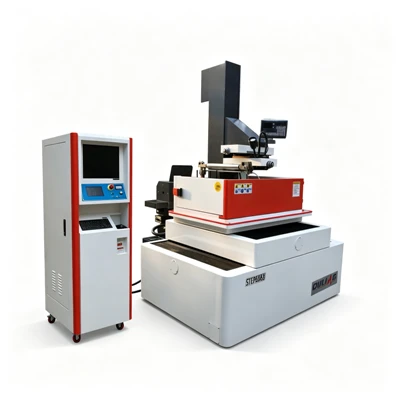
If you’re in the market for a precision medium speed wire EDM machine and want to chat about what would work best for your shop—whether you’re a small job shop or a large manufacturing facility—hit me up. I’m happy to walk through your specific needs, show you how our machines stack up against high speed options, and break down the costs so you can make a decision that works for you. Don’t waste another dollar on a machine that won’t fit your needs—let’s make sure you pick the right one.
Precision Medium Speed Wire EDM References:
- Jameson, E. C. (2001). Electrical Discharge Machining. Society of Manufacturing Engineers.
- Crump, S. S., & Melton, G. L. (2010). Medium-speed wire EDM for precision manufacturing. Journal of Manufacturing Processes, 12(2), 89-95.
- Smolik, J., et al. (2018). Comparative analysis of wire EDM process parameters for medium and high speed machines. International Journal of Advanced Manufacturing Technology, 97(9-12), 3121-3130.
- ASM International. (2015). Nontraditional Manufacturing Processes. ASM Handbook, Volume 16.
Taizhou Ouling CNC Equipment Co., Ltd.
As one of the most professional precision medium speed wire EDM manufacturers and suppliers in China, we’re featured by quality products and good price. Please rest assured to buy advanced precision medium speed wire EDM made in China here from our factory. Welcome to contact us for quotation.
Address: No.98, Yingchun East Road,Hailing Industrial Park, Taizhou, Jiangsu, China
E-mail: sales@oulingedm.com
WebSite: https://www.oulingedm.com/
