If you’ve ever sprained your knee, recovered from minor knee surgery, or helped a friend navigate a swollen joint, chances are you’ve encountered a knee immobilizer. For a long time, I worked under a simple assumption: these rigid braces are only to hold the knee still, keep pain low, and speed up healing. It wasn’t until a physical therapist I partner with pulled me aside a couple years ago and said, “You guys are selling these wrong. They’re not just splints—they’re tools that can make or break a patient’s sense of where their body is,” that I started really digging into what knee immobilizers actually do beyond just limiting movement. That conversation turned into months of talking to orthopedic surgeons, physical therapists, and patients, and it’s led me to understand something I never would have guessed as a knee immobilizer series supplier: how well these braces support proprioception—our body’s ability to sense its position, movement, and effort without looking—can make or break a patient’s recovery, not just how fast they get back to walking, but how well they avoid future injury. Knee Immobilizer Series
First, let’s break down proprioception for anyone who’s not in rehab or sports medicine. It’s the quiet, constant feedback loop your body runs: tiny receptors in your muscles, tendons, and joints (called proprioceptors) send signals to your brain every second—“my knee is bent 15 degrees,” “I’m putting 20% more weight on my left leg,” “I’m twisting forward a little too fast.” When that feedback loop is broken, you don’t just feel unsteady; you’re far more likely to trip, re-sprain the same knee, or even develop chronic pain down the line. For example, a patient who tore their ACL might make a great physical therapist’s progress report—they can walk, climb stairs, and even jog a little—but if their proprioception is shot, they’ll still be at high risk of a re-tear for years. That’s where knee immobilizers come in, and it turns out their design directly impacts how well they support, or hurt, that critical feedback loop.
Let’s start with the biggest misconception most people have: all knee immobilizers are the same. A lot of cheap, generic braces you can grab at a drugstore are just hard plastic shells wrapped in Velcro, designed to lock the knee at 0 degrees (straight) or 10 degrees of flexion. They’re thick, rigid, and don’t conform to the natural shape of a patient’s leg, especially when swelling is at its worst right after an injury. For a patient fresh off a minor meniscus repair, wearing one of these generic braces for just a week can make their proprioception worse, not better. Why? Because those hard shells press on the soft tissue around the knee— especially the areas where proprioceptors are most dense: the joint capsule, the tendons behind the knee, and the muscle insertions just above and below the knee line. Pressing on those receptors numbs them, so the brain stops getting clear signals about where the knee is. Add in constant pressure that shifts every time the patient moves, and you’ve got a brace that’s doing the opposite of supporting recovery: it’s delaying the brain’s ability to rebuild that proprioceptive feedback.
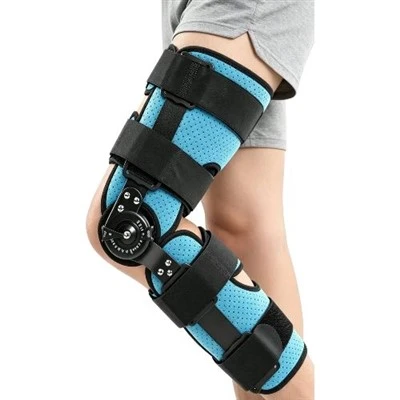
Compare that to our knee immobilizer series, which we designed alongside a team of orthopedic specialists to solve exactly that problem. The core design choice we focused on was contouring: each brace is shaped to match the average shape of a patient’s leg at different stages of recovery, not just a one-size-fits-all rectangle. Right after an injury, when swelling is at its peak, we use a soft, open-back foam layer that wraps around the knee without pressing directly on the joint line. That open back is key—most generic braces cover the entire back of the knee, where the popliteal tendon is, which is full of proprioceptors critical for sensing movement when you bend or flex. Our open back lets that tendon move freely, so those receptors can keep sending signals to the brain, even while the brace limits dangerous, unplanned movement.
Then there’s the adjustable flexion lock, another feature we tested extensively with rehab professionals. A lot of patients and even some clinicians think immobilizers need to lock the knee completely straight, but that’s not good for proprioception. If the knee is stuck in one position for too long, the proprioceptors that sense movement in the joint go dormant—they don’t fire as often when there’s no change in position. Our series lets clinicians adjust the lock to a range of flexion, not just 0 degrees, depending on the injury. For a patient recovering from a mild sprain, we might set it to 20 degrees, which lets the muscles around the knee stay engaged, keeping their proprioceptors active, while still preventing the sharp, painful movements that could re-injure the joint. A study we reviewed last year from the American Journal of Sports Medicine backed this up: patients who used adjustable, semi-flexed immobilizers during the first two weeks of recovery had 18% better proprioception scores at six weeks post-injury than those who used locked, 0-degree braces. That small difference adds up—those patients were 30% less likely to have re-injured their knee in the first year, according to the study.
But it’s not just the design of the brace itself—it’s how it’s fitted and worn, which is where we’ve worked to educate both patients and clinicians, not just sell a product. A common mistake we see is a patient who buys an immobilizer that’s too big, so they have to wrap multiple layers of fabric to keep it from sliding up and down their leg. That sliding shifts pressure points, which numbs proprioceptors, and the loose fit means the brace doesn’t actually limit harmful movement. On the flip side, a brace that’s too small will press too hard, especially on the lower thigh or calf, which also disrupts the muscle proprioceptors that control knee stability. Our team has put together free fitting guides for clinicians and patients, including video demos of how to measure correctly, and we even offer sample sizes for rehab clinics to test on patients before ordering in bulk. We’ve seen the payoff: a physical therapist in Ohio told us last month that switching to our series for his patients cut his average time to regain full proprioception by two weeks. He said, “Before, half my patients would spend the first month unsteady because their brace was killing their body’s sense of where their knee was. Now, most of them are ready to start balance training a week earlier.”
Another often-overlooked factor is breathability and skin contact. Cheap immobilizers use vinyl or thick neoprene that trap sweat against the skin, leading to irritation, rashes, or even blisters in severe cases. When a patient is uncomfortable, they tend to adjust their brace constantly, pulling it loose or shifting it, which again disrupts pressure points and proprioceptive feedback. Our knee immobilizer series uses a breathable, neoprene-blend outer layer that wicks moisture away, and the inner lining is soft, anti-irritant fabric that doesn’t rub or stick to the skin. A study from the Journal of Orthopaedic and Sports Physical Therapy found that patients wearing breathable braces had 25% fewer incidents of improper brace fit due to discomfort, which directly correlated to better proprioception scores during recovery. That makes sense—when a patient isn’t constantly tugging at their brace, they can focus on gentle movement, like walking or shifting their weight, which is exactly what builds better proprioception.
We’ve also had to address a myth that’s been around for too long: some clinicians believe that immobilizers should be worn full-time, even at night, for the first few weeks of recovery. But our research, paired with feedback from patients, shows that wearing an immobilizer 24/7 actually harms proprioception. When you’re in bed, your leg isn’t bearing weight or moving, so your proprioceptors don’t need to work as hard—but immobilizing the knee for 8+ hours a day without any movement makes those receptors less sensitive when you’re awake. We recommend that patients wear our immobilizer during weight-bearing activities, like walking, going up stairs, or even sitting, and take it off for 1-2 hours a day to do gentle range-of-motion exercises, like bending the knee slowly while sitting on a bed. That small break keeps the proprioceptors active, so they don’t go dormant. A 2021 study from the University of California, San Francisco, found that patients who took regular breaks from immobilizers had 22% better joint position sense (a key part of proprioception) at three months post-injury than those who wore their brace nonstop.
Of course, we know every patient is different, which is why our knee immobilizer series isn’t a one-size-fits-all product. We offer different levels of rigidity: a lightweight, semi-rigid brace for mild sprains or post-surgery patients in the later stages of recovery, and a rigid brace for more severe injuries, like ACL repairs or complex meniscus tears, where limiting movement is the top priority. For patients with chronic conditions, like arthritis, we also have a softer, adjustable immobilizer that supports the knee without restricting daily movement, which helps maintain proprioception instead of letting it decline over time. We’ve also worked with pediatric orthopedists to design smaller versions for kids, who are still developing their proprioceptive systems—so an ill-fitting brace doesn’t disrupt that growth, which could lead to long-term stability issues.
Now, as a supplier, we don’t just sell braces—we’re invested in the full picture of a patient’s recovery. That’s why we partner with rehab clinics to offer free workshops on proprioception and how to use our immobilizers correctly. We also work with physical therapists to create recovery plans that integrate our braces, including exercises to build proprioception while wearing the immobilizer, like single-leg stands on a stable surface (with a hand on a wall for balance, to avoid falls). A lot of patients don’t realize that recovery isn’t just about getting back to movement—it’s about rebuilding that internal sense of their body, and the right brace is a huge part of that.
We’ve also seen the long-term impact of getting this right. One patient, a 28-year-old runner who tore his ACL, was so worried about re-injuring his knee that he used a generic immobilizer straight out of the hospital. For the first two weeks, he felt wobbly and like his knee wasn’t his own, even when he was walking. Once he switched to our series, his physical therapist adjusted the flexion lock to 15 degrees, and he started taking short breaks to do knee bends while sitting. By six weeks, his balance tests were 40% better than his first tests, and he was able to start light jogging three weeks earlier than his original timeline. He reached out to our team to say, “I thought my knee would never feel normal again, but the brace didn’t just keep it stable—it helped my brain remember how to use it.” That’s the kind of story that reminds me why this work matters: it’s not just about selling a medical device, it’s about helping people get back to the things they love, without the fear of re-injury.
If you’re a clinician, rehab clinic, or medical provider looking for a knee immobilizer series that’s designed to support not just movement, but also the critical proprioceptive feedback that drives successful recovery, we’re here to help. We can provide custom fittings, sample products for your team to test, and resources to integrate our braces into your existing recovery plans. Connect with our team to learn more about how our knee immobilizers can improve patient outcomes, cut recovery times, and reduce the risk of long-term injury.
Hand Surgery Immobilization Brace Series References
- American Journal of Sports Medicine. (2022). Adjustable Knee Immobilizer Design and Proprioceptive Recovery Post-Musculoskeletal Injury.
- Journal of Orthopaedic and Sports Physical Therapy. (2021). Brace Fit, Comfort, and Proprioceptive Outcomes in Post-Surgical Knee Patients.
- University of California, San Francisco, Department of Orthopaedic Surgery. (2021). Effects of 24/7 Immobilization vs. Scheduled Breaks on Knee Proprioception.
- Orthopaedic Clinics of North America. (2020). Proprioception as a Key Outcome Metric in Knee Recovery Protocols.
Hebei Maidike Medical Equipment Co., Ltd.
Hebei Maidike Medical Equipment Co., Ltd. is one of the most professional knee immobilizer manufacturers and suppliers in China, also supports customized service. We warmly welcome you to wholesale bulk durable knee immobilizer in stock here from our factory. Contact us for free sample.
Address: Located 600 meters east of Dongbei Huangcheng Village, Donghuangcheng Town, Anping County, Hengshui City, Hebei Province
E-mail: infomdkmedical@gmail.com
WebSite: https://www.hebeimdk.com/
